RESEARCH
Research & Technical Work
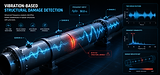
Felementa’s work is supported by ongoing research and development in vibration-based structural health monitoring methodologies for offshore and subsea infrastructure. Current work integrates analytical modelling, finite element analysis, and experimental validation approaches to support development of reliable condition assessment methodologies under operational conditions.
PUBLICATIONS
Esu, OE, Wang Y & Chryssanthopoulos MK (2021)
Local Vibration Mode Pairs for Damage Identification in Axisymmetric Tubular Structures
Journal of Sound and Vibration (Elsevier)
Presents a vibration-based methodology for identifying and localising structural damage in axisymmetric tubular structures through modal frequency splitting behaviour. The work demonstrates how paired local vibration modes can be used as sensitive indicators of structural asymmetry and damage in offshore structural systems.


Esu, OE, Wang Y & Chryssanthopoulos MK (2022)
A Baseline-free Method for Damage Identification in Pipes from Local Vibration Mode Pair Frequencies
Structural Health Monitoring (SAGE Publications)
Introduces a baseline-free vibration-based methodology for structural damage identification in pipelines using local vibration mode pair frequencies. The research demonstrates reliable condition assessment capabilities without dependence on historical baseline measurements under operational conditions.

Ongoing Research

Vibration-Based Damage Identification Under Operational Conditions
Current research investigates the influence of operational parameters—including internal pressure, environmental loading, and structural asymmetry—on vibration-based damage identification methodologies for tubular and offshore structures. The work integrates finite element modelling and experimental approaches to evaluate robustness and sensitivity of monitoring methodologies.

Damage Localisation Using Excitation Direction
Research investigates the influence of excitation orientation on modal observability and localisation of structural damage in axisymmetric structures. The work evaluates variations in modal response characteristics under different excitation directions to support improved damage localisation methodologies.
TECHNICAL METHODS
Our research and development work integrates multiple analytical and experimental techniques, including:
Experimental modal analysis
Frequency response function (FRF) analysis
Finite element modelling and dynamic simulation
Vibration-based condition assessment methodologies
Signal processing and response interpretation
Structural response characterization under operational conditions
CASE STUDY
MODAL FREQUENCY SPLITTING FOR DAMAGE IDENTIFICATION IN
TUBULAR STRUCTURES
This study investigates the use of vibration-based modal response characteristics for structural damage identification in tubular structures representative of offshore and subsea infrastructure. The work combines finite element modelling and experimental modal analysis to evaluate how structural asymmetry introduced by localised damage influences paired vibration modes and frequency splitting behaviour. The methodologies were developed to support reliable condition assessment under operational conditions where conventional baseline-dependent approaches may be difficult to apply.
Key Findings
✔ Amplitude beating observed in the time-domain response was found to be characteristic of structural damage and modal frequency splitting.
✔ Localized structural damage produced measurable frequency splitting in paired vibration modes, enabling identification of structural asymmetry.
✔ Experimental and numerical investigations demonstrated consistent trends in modal response behaviour under varying damage conditions.
✔ The methodologies support development of baseline-free structural health monitoring approaches for offshore and subsea infrastructure.
Time domain amplitude modulation from modal frequency splitting


Frequency splitting observed in the frequency response function